


Urdu AI Voice: How Pakistani Enterprises Are Using Intelligent Voice Technology
Enterprise Urdu AI voice is no longer a roadmap item in Pakistan's regulated sectors, it is in production at PITB's Citizen Contact Center (300,000+ calls a month) and actively being deployed at Bank of Punjab. This guide explains how it works, what makes it different from consumer tools, and what a real deployment looks like.

Pakistan has more than 230 million people. The majority prefer voice over text when resolving a problem or finding information. For banks, government agencies, and telecoms serving these citizens, building services that communicate in Urdu is not optional. It is the baseline.
This is where urdu ai voice technology is changing how organisations handle customer and citizen interactions at scale. This guide explains what enterprise Urdu AI voice actually is, how it differs from consumer tools, and how organisations are using it in production today.
What Is Urdu AI Voice?
Urdu AI voice is not a text-to-speech tool that reads typed words aloud in a synthetic accent. Enterprise-grade Urdu AI voice combines three technology layers working together:
- Automatic Speech Recognition (ASR): Converts a caller's spoken Urdu into text the system can process
- Natural Language Understanding (NLU): Identifies what the caller means, not just the words they used
- Text-to-Speech (TTS): Generates a natural-sounding, contextually appropriate Urdu response
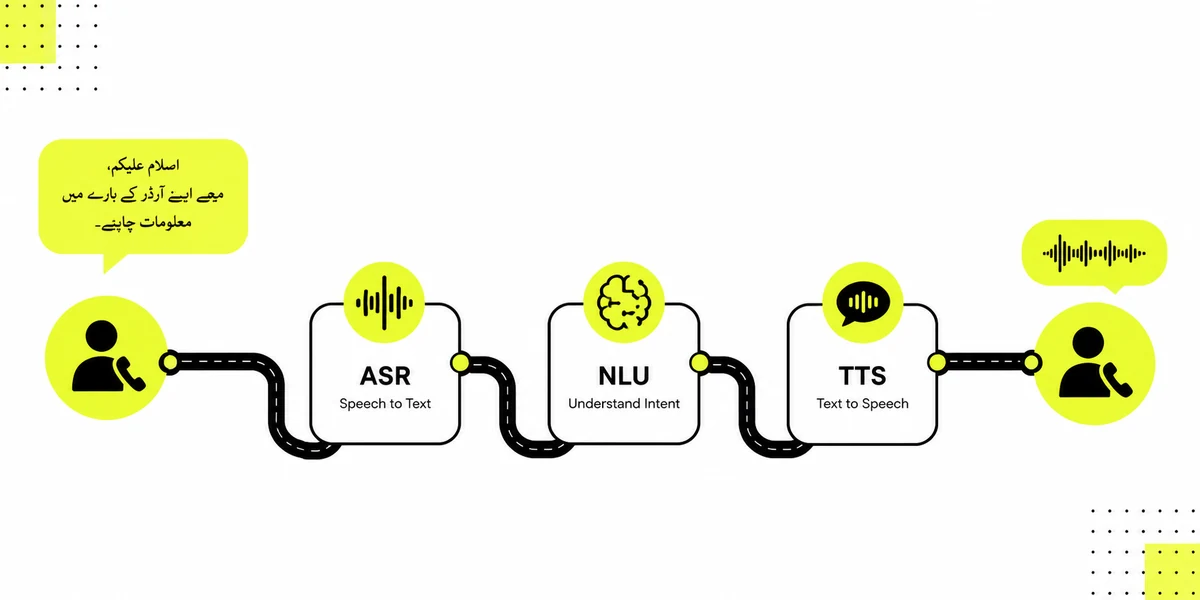
Together, these three layers allow a system to hold a real two-way conversation in Urdu, without a human agent involved for routine queries.
The Urdu text-to-speech (Urdu TTS) layer is what callers actually hear: a voice trained on Pakistani regional speech that sounds natural, not a generic synthesised voice that reads words without context.
Urdu Speech Recognition: The Input Layer That Makes It Work
Urdu speech recognition is where every voice AI deployment starts. When a caller speaks, the ASR engine transcribes their spoken Urdu into text in milliseconds, before any intent detection or routing happens downstream.
General-purpose ASR models fail on Pakistani Urdu. Urban speakers frequently mix Urdu with English mid-sentence. Regional accent patterns vary across Punjab, Sindh, KPK, and Balochistan. Banking and government vocabulary diverges sharply from everyday speech. Closing that gap requires a model trained on data collected from Pakistani callers in your domain, not an off-the-shelf global model applied to a language it was never built for.
In the PITB Citizen Contact Center deployment, Urdu speech recognition accuracy on domain-specific vocabulary improved substantially after fine-tuning on actual call transcripts from the Punjab government helpline — the kind of gain that makes the difference between a voicebot callers trust and one they abandon after the first failed interaction.
Why Urdu Presents Unique Technical Challenges
Urdu is a morphologically rich language with right-to-left script. It varies significantly across Punjab, Sindh, KPK, and Balochistan. Urban speakers frequently mix Urdu with English in ways that trip up standard models.
Most multilingual voice models are trained on English or Hindi-adjacent data. They perform poorly on Pakistani Urdu in real conditions. Effective urdu ai voice systems need training data collected specifically from Pakistani speakers across regions and domains. This is not a gap a general-purpose model can close. It requires deliberate, domain-specific data collection and fine-tuning.
Why Urdu AI Voice Matters for Pakistani Businesses
Two realities make the case for Urdu AI voice in Pakistan's regulated sectors.
The first is access. A large share of Bank of Punjab's retail customers reach the bank by phone, not a mobile app. Many citizens contacting government helplines are not comfortable with text-based digital interfaces. Voice is not a legacy channel. It is the primary accessible interface for a significant portion of Pakistan's population.
The second is scale. Regulated sectors face growing pressure to document, route, and audit every customer interaction. PITB's Citizen Contact Center handles over 300,000 calls a month, serving Punjab's 110 million residents. Managing that volume manually creates both an operational cost problem and a compliance risk. Automated Urdu AI voice addresses both at once.
Key Enterprise Use Cases for Urdu AI Voice
Banking: Automated Urdu IVR for Account Queries
In our ongoing implementation with Bank of Punjab, the primary use cases being built out are account balance enquiries, transaction alerts, and loan status updates in conversational Urdu. The system is designed to identify caller intent and handle routine queries directly, without escalating to a human agent. The expected outcome is reduced average handle time and the ability for agents to concentrate on cases that genuinely require human judgement.
The model is trained on banking-specific Urdu vocabulary. Terms like منافع (profit, in an Islamic banking context), قرض (loan), and شاخ (branch) are handled correctly. Generic voice models routinely misclassify these.
Government: Citizen Contact Centres at Scale
PITB's Citizen Contact Center serves Punjab residents across health, utility, education, and civic services. Citizens call in Urdu, Punjabi, and code-switched Urdu-English. Manually routing each call based on spoken intent is not operationally viable at that volume. The centre handles over 300,000 calls a month.
Urdu AI voice handles the intake layer. It identifies the reason for the call, confirms key details, and either resolves the query directly or routes it to the right department with a pre-filled summary. Agents receive calls already categorised and documented, cutting intake time significantly.
Telecom: Urdu Voicebot for Prepaid and Postpaid Support
Telecom operators in Pakistan field high volumes of balance, bundle, and SIM-related queries. An Urdu AI voicebot for first-line support reduces cost per interaction substantially while keeping the Urdu-first experience customers expect.
How to Choose an Urdu AI Voice Generator for Your Enterprise
Consumer urdu ai voice generator tools are built for individual content creators: podcast narration, YouTube voiceovers, and audiobook production. They produce audio output well. They are not built for two-way conversations with callers who have not been prompted about what to say.
Enterprise requirements are different. Five criteria matter when evaluating an Urdu AI voice solution for business:
- Conversational capability: Can it understand spoken input, or does it only produce audio?
- Pakistani dialect coverage: Is the model trained on Pakistani Urdu specifically, or on Hindi-adjacent broadcast data?
- On-premise deployment: Regulated sectors including banking and government often cannot route live call audio through a third-party cloud. Data sovereignty is a compliance requirement, not a preference. See how Poocho AI handles on-premise and sovereign cloud deployment.
- Telephony integration: Does it connect to your existing PBX or contact centre without a full infrastructure overhaul?
- Auditability: Can every conversation be logged and retrieved for regulatory review?
Consumer TTS tools fail on criteria 1, 3, 4, and 5. They are not designed for the operational and compliance environment of a Pakistani bank or government agency.
What to Expect When Deploying Urdu AI Voice
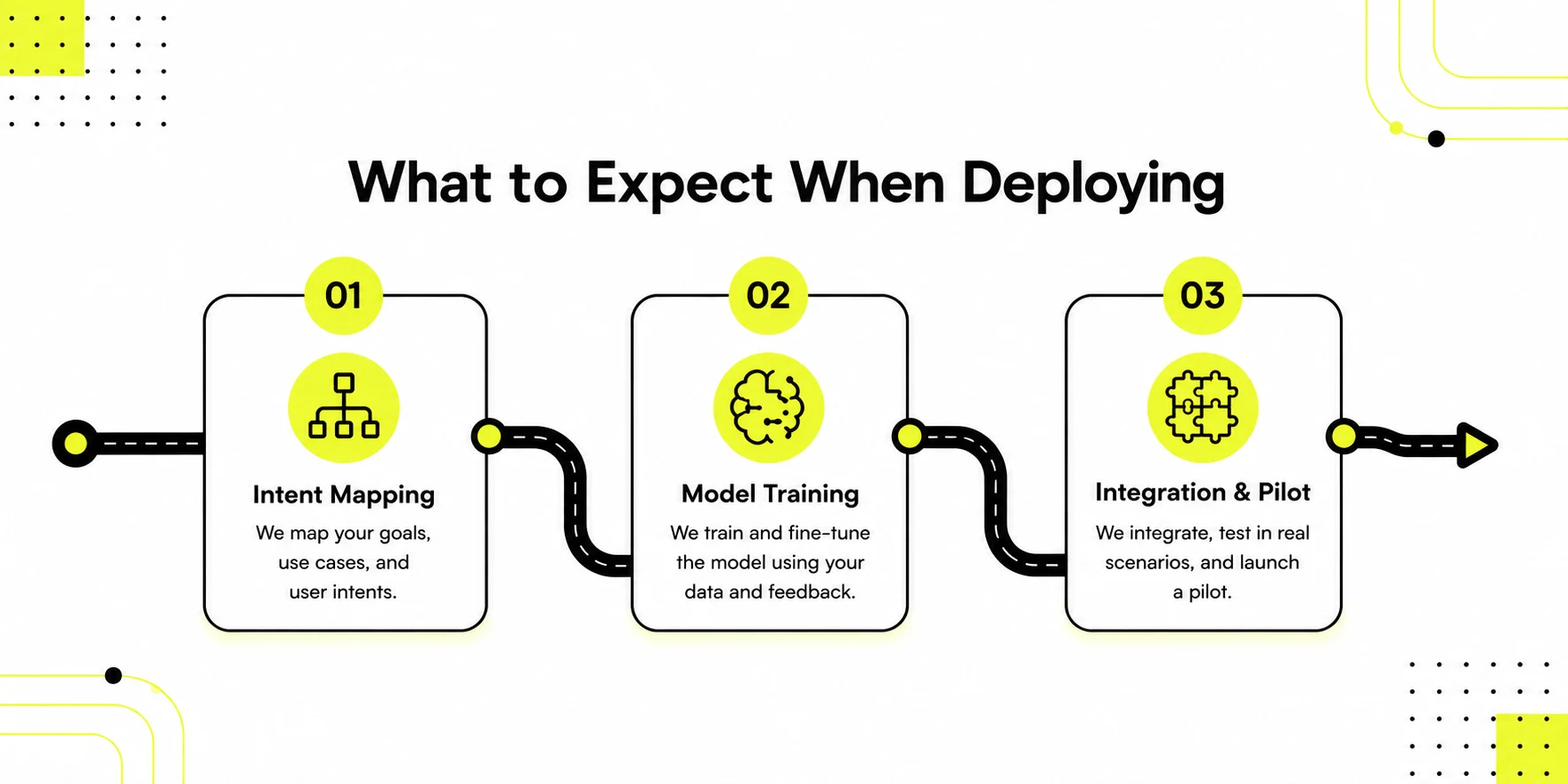
A well-scoped enterprise deployment follows three stages.
The first is intent mapping: documenting the 20 to 30 caller intents that account for 80 percent of inbound volume. This is done with your operations and compliance teams, not by the vendor alone.
The second is model training and testing: training ASR on your actual caller demographics and domain vocabulary, then testing NLU accuracy on real historical transcripts before go-live.
The third is integration and pilot: connecting to telephony, running a controlled pilot on a defined call subset, and measuring containment rate, which is the share of calls resolved without human escalation.
Most deployments move from scoping to a live pilot in 8 to 12 weeks, depending on integration complexity.
Frequently Asked Questions
What is the best Urdu AI voice generator for businesses?
For individual content creation, consumer tools offer high-quality Urdu audio output at accessible pricing. For business applications that require two-way conversation, telephony integration, and on-premise deployment in regulated environments, purpose-built enterprise platforms are the right choice. The distinction matters: one produces audio files, the other holds live conversations at scale.
Can Urdu AI voice handle different regional accents?
Yes, if the model was trained on geographically diverse Pakistani data. Pakistani Urdu varies meaningfully between Lahore, Karachi, and Peshawar. Models trained only on broadcast Urdu or Hindi-adjacent recordings underperform on regional or rural speech. When evaluating vendors, ask specifically for word error rate figures on Pakistani caller recordings across different regions.
Is Urdu AI voice accurate enough for regulated sectors like banking?
At the accuracy thresholds achieved by models fine-tuned on domain-specific data, yes. General-purpose ASR models struggle with Urdu banking and government terminology. Models trained specifically on financial services call data perform materially better. Containment rates above 70 percent for routine banking queries have been demonstrated in live deployments.
What is Urdu AI?
Urdu AI refers to artificial intelligence systems, voice or text, that operate in the Urdu language. This includes voice assistants, chatbots, translation tools, and content generation platforms. In an enterprise context, urdu ai most commonly refers to conversational AI deployed on telephony and messaging channels to serve Pakistan's Urdu-speaking population at scale.
Ready to explore Urdu AI voice for your organisation?
Book a 30-minute demo. Bring your call types and we'll show you exactly what's possible in Urdu at enterprise scale.