

If your organisation is evaluating an AI call center in UAE, the timing matters. The UAE government announced a national framework to deploy agentic AI across 50% of federal government services within two years. Banks, telecoms, and government agencies treating AI call center deployment as a future consideration are already behind organisations that have been running pilots for the past eighteen months.
This guide covers what actually matters for getting the foundations right: what AI call centers are in a regulated MENA context, how they work with Arabic and English, and what compliance requires under UAE law.
What Is an AI Call Center, and How Is It Different from What UAE Enterprises Have Today?
Traditional IVR vs AI Call Center: The Actual Difference
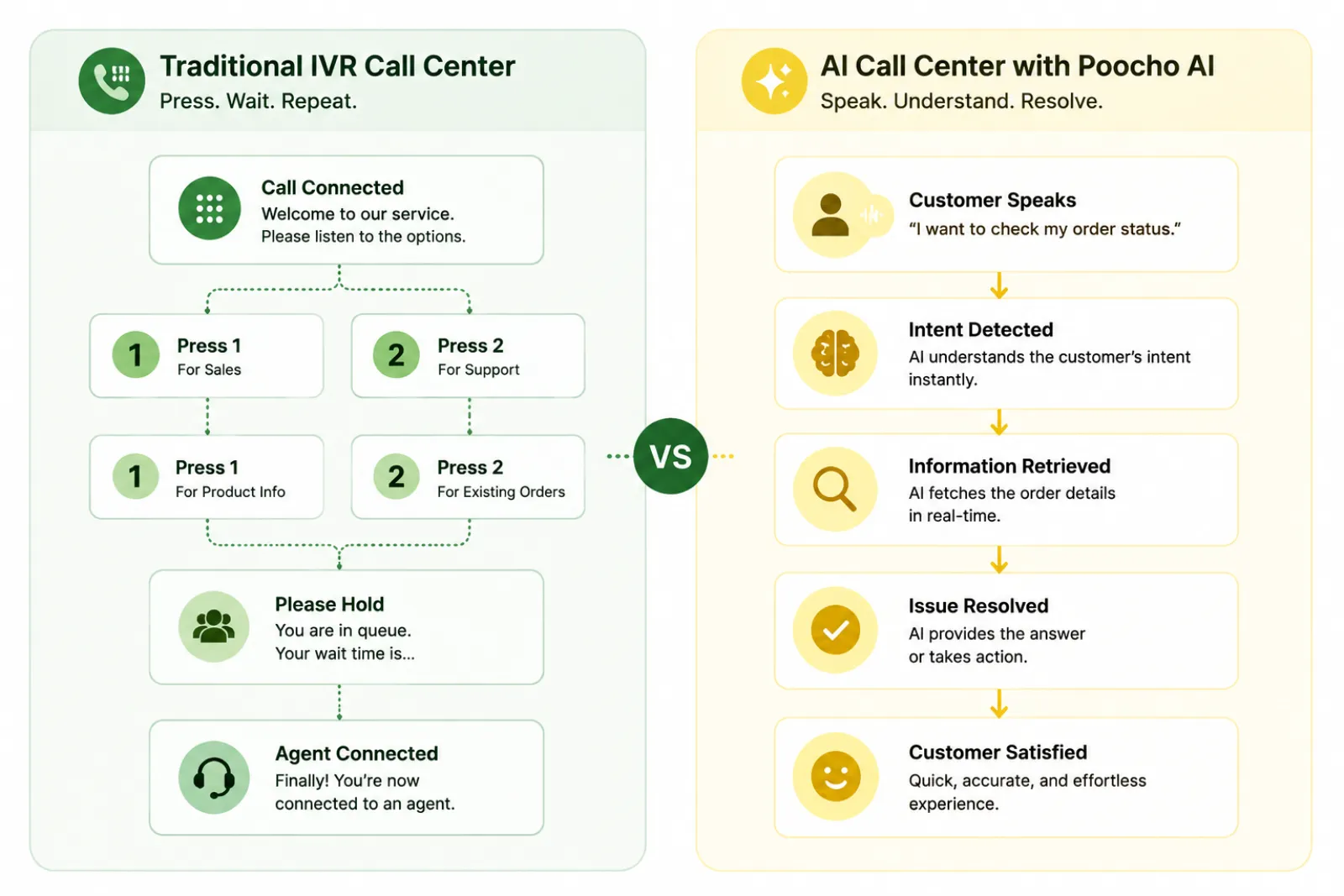
Most large UAE enterprises (banks, telecoms, government departments) run IVR-based contact centers. A caller hears a menu, presses a number, gets routed to a queue, and eventually reaches an agent who resolves the query. The IVR's job is routing, not resolution.
An AI call center changes that function entirely. Instead of a menu, the caller speaks naturally. The AI understands the intent, not a keyword but the actual meaning behind what the customer said, and matches it against a knowledge base, resolving it without human intervention for the defined scope of queries. When a query falls outside that scope, the AI transfers the call with full context already documented.
The difference that matters operationally: IVR measures success by routing accuracy. AI call centers measure success by resolution rate. Those are fundamentally different outcomes.
What "AI Call Center" Means in a Regulated MENA Market
In UAE, an AI call center decision is not just a technology choice. It is three decisions made simultaneously:
- A compliance decision: what the AI can and cannot say to a customer under regulatory frameworks
- A data residency decision: where call recordings and transcripts are stored
- A language infrastructure decision: which dialects and code-switching patterns the system must handle
A platform that works without modification in the US or India is unlikely to be compliant in UAE banking or government out of the box.
Why UAE Enterprises Are Moving to AI Call Centers Now
The Arabic and English Contact Center Reality: Why Most AI Vendors Get Arabic Wrong
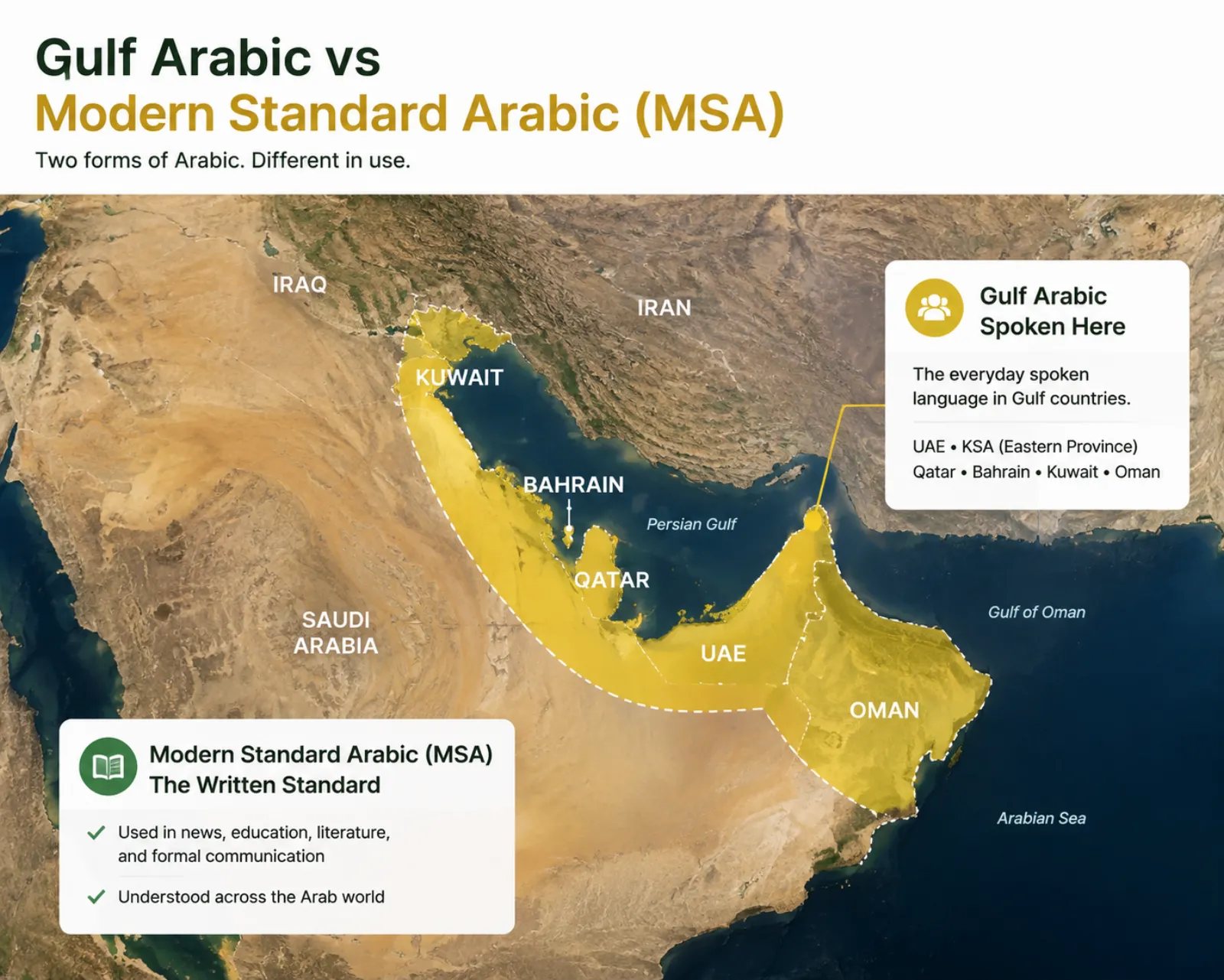
Arabic is not a language toggle. Modern Standard Arabic (MSA), which most global AI vendors use to build their Arabic models, is the formal written variant: the language of news broadcasts and official documents. UAE customers speak Gulf Arabic: a dialect with substantively different vocabulary, phonology, and phrasing from MSA.
When a UAE customer calls and speaks Gulf Arabic to an AI trained on MSA, the system either misunderstands the query or defaults to an English response. Both outcomes create the escalation that the AI call center was deployed to prevent. English in UAE contact centers carries its own specifics: Arabicised phrasing, local reference points, and the mid-sentence code-switching between Arabic and English that is standard in UAE professional interactions. Vendors who cannot demonstrate their system working under real Gulf Arabic conditions are not ready for UAE deployment.
Cost Pressure: What Traditional Call Centers Cost in AED
UAE contact center operations are among the more expensive in the region. Labor regulations, real estate costs in Dubai and Abu Dhabi commercial zones, and the compliance overhead of regulated-sector customer service push per-agent costs significantly higher than comparable operations in South Asia or North Africa.
AI call center automation targets the high-volume, low-complexity call types that represent a substantial portion of inbound traffic: account balance inquiries, branch hours and locations, appointment scheduling, payment confirmations, and status updates. For organisations where these query types represent 40–60% of inbound volume, typical across banking and government contact centers, the economics of routing those calls to AI rather than agents are straightforward to model. The ROI case in UAE is stronger than in lower-cost markets precisely because the gap between AI interaction cost and human agent cost is wider.
The Agentic AI Mandate and What It Signals for the Private Sector
In May 2026, the UAE Cabinet approved a national framework targeting 50% of federal government sectors, services, and operations running on agentic AI within two years. Dubai separately announced a transformation plan targeting 295,000 companies with 100 AI assistants and 50 new AI firms backed by the initiative.
For private-sector enterprises, the signal is clear: regulatory comfort with AI in customer-facing operations is increasing at pace. Financial institutions that have been cautious about deploying AI in customer service will face competitive pressure as government services move first, and as UAE customers become accustomed to AI-first interactions with public entities.
How AI Call Centers Work in Practice
Inbound: Intent Recognition, Routing, Resolution
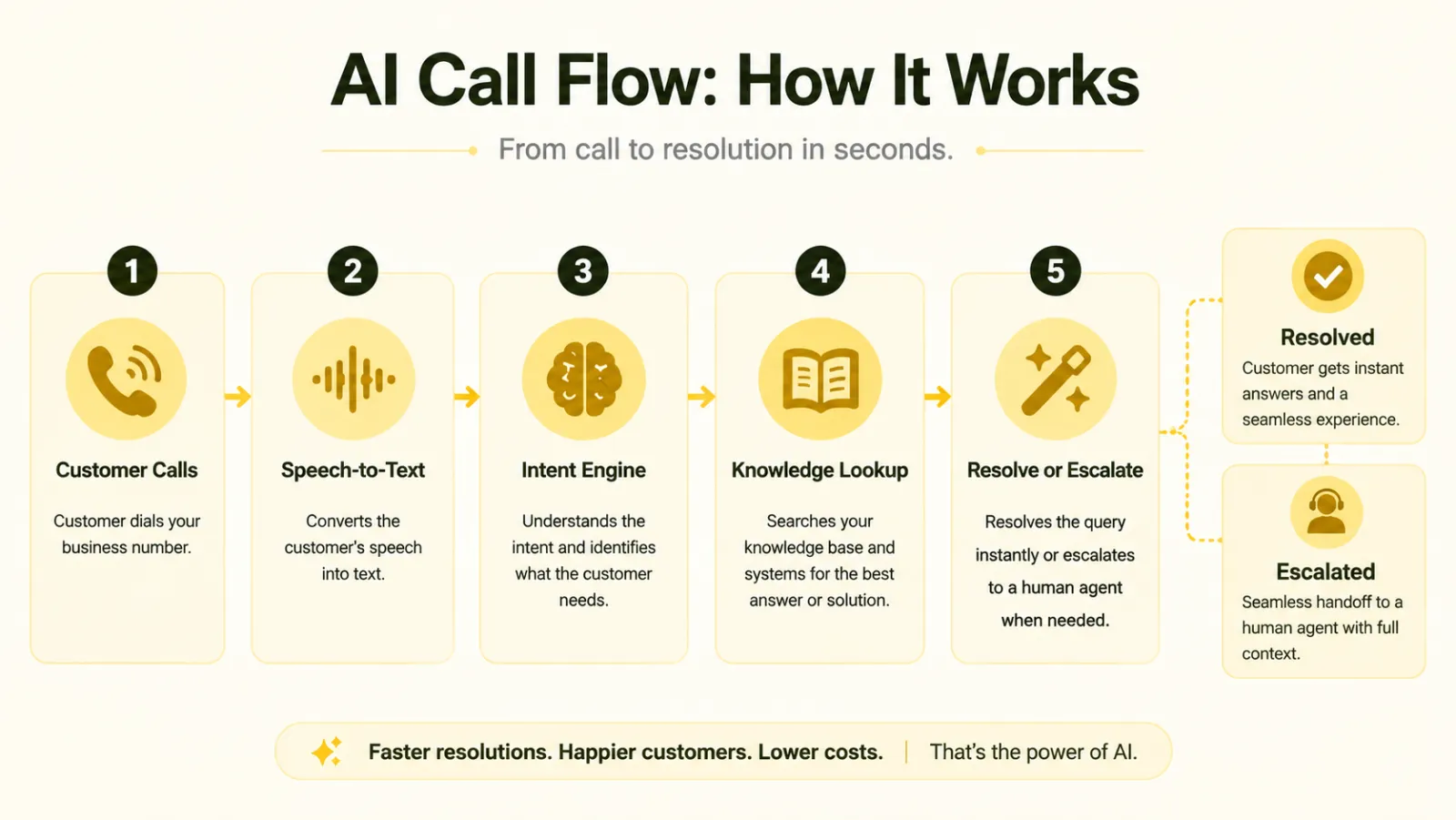
A customer calls. Instead of menu navigation, they say what they need. The AI processes the audio, converts it to text, identifies the intent ("check last three transactions," "report a lost card," "find the nearest branch open on Saturday"), and queries the appropriate backend system. For resolved queries, the AI confirms the outcome and ends the call. For queries outside its defined scope, it transfers with full context: the customer does not repeat themselves to the human agent.
The quality of the intent recognition layer is where AI call center deployments succeed or fail. A system that misclassifies intent at more than 5–10% of calls creates escalation volume that erodes the cost case entirely.
Outbound: Follow-ups, Reminders, Collections
AI call center value in UAE extends beyond inbound. Outbound use cases (payment reminders, loan EMI follow-ups, appointment confirmations, policy renewal alerts) deliver significant ROI in banking and insurance, and are typically lower in technical complexity than inbound because the conversation scope is narrower. Outbound AI calls in UAE require explicit prior consent from the recipient, a PDPL and TDRA requirement covered in the compliance section below.
Escalation: When and How AI Hands Off to a Human Agent
Escalation design is the most important element of an AI call center implementation, not the AI itself. Three triggers should always escalate to a human: sentiment signals indicating customer frustration or distress; queries that fall outside the AI's defined knowledge scope; and any interaction where the AI's confidence in its own understanding drops below a defined threshold. When escalation happens, the human agent receives a full call transcript with the AI's classification of query type. The customer does not re-explain their situation.
What Genuine Arabic Voice AI Requires Technically
Gulf Arabic voice AI requires more than translating an English model. The acoustic model must be trained on Gulf Arabic phonology specifically, not generic Arabic. The language model must handle Arabic-English code-switching, which is standard in UAE professional and consumer interactions. Backend text processing must handle right-to-left Arabic text in integration with CRM and core banking systems. Additionally, noise tolerance matters: calls from vehicles, shopping malls, or construction-adjacent locations are standard in UAE. A system that degrades significantly in high-noise conditions is not production-ready.
What Enterprise Deployments at Scale Teach You About AI Call Centers in Regulated Markets
Banking Sector: Compliance-First Deployment at Bank of Punjab
Bank of Punjab deployed Poocho AI's conversational platform for customer service automation across its contact center operations, in Urdu and English. The deployment handles account inquiries, branch locator queries, product information, and complaint registration across a high-volume banking environment. The full context is in the Bank of Punjab case study.
What the Bank of Punjab deployment established most clearly: in regulated banking environments, the compliance framework is designed before the first line of voice AI configuration is written. What the AI can confirm, what it cannot commit to, which query types must reach a licensed human agent: these decisions are made in collaboration with compliance teams and documented before go-live. That methodology is directly transferable to what CBUAE-regulated institutions in UAE require.
Government Citizen Services: PITB at 300,000+ Calls Per Month
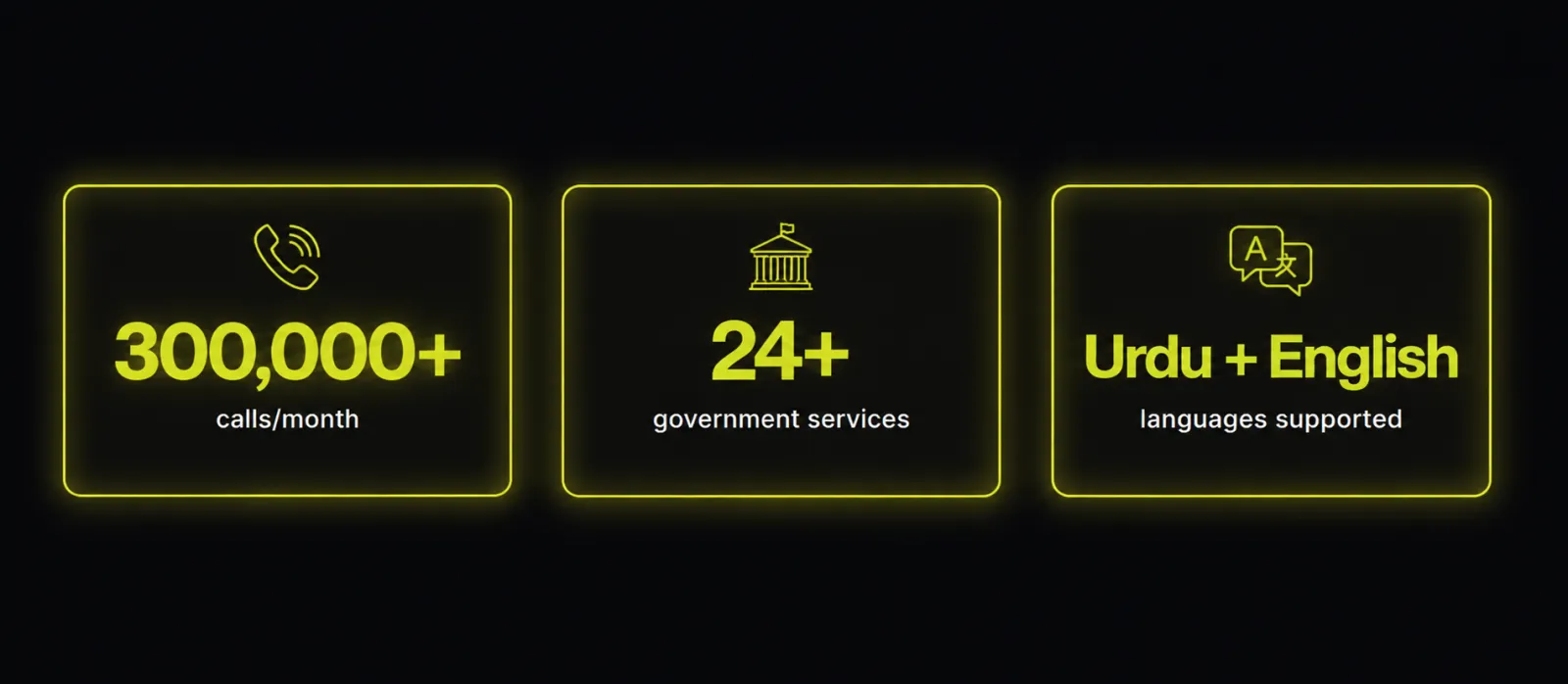
The Punjab Information Technology Board (PITB) Citizen Contact Center runs on Poocho AI's platform at a scale that few AI call center deployments reach: over 300,000 calls per month, covering more than 24 government services, in Urdu and English. The full deployment detail is in the PITB case study.
At that volume, infrastructure reliability and on-premise deployment are not optional: they are preconditions. Government services cannot route citizen calls through external cloud infrastructure. The on-premise deployment model PITB requires is the same model UAE government entities articulate when evaluating AI call center vendors.
What These Deployments Prove About the Architecture
The PITB and Bank of Punjab deployments are Urdu-language operations in Pakistan. The language and market are different from UAE. What transfers directly is the architecture and the deployment methodology: on-premise deployment at production scale, regulated-sector compliance design covering what is automated and what is not, high-volume handling without call quality degradation, and human oversight integration for complex queries. These are the foundations that make a regulated-sector AI call center work regardless of language or geography. The call center automation experience from Pakistan provides a direct reference point for the architecture any UAE enterprise would be building toward.
Are AI Calls Legal in UAE? The Compliance Framework
UAE PDPL: What It Means for Call Recording and Data Storage
Federal Decree-Law No. 45 of 2021 governs how personal data is collected, processed, and stored. AI call center interactions generate personal data at every step:
- Caller identity
- Query content
- Voice recording
- Call transcript
PDPL requires a documented lawful basis for processing that data. For inbound customer service calls, the lawful basis is typically contractual necessity. For outbound AI calls, explicit consent is the correct basis and must be obtained before the call is made.
Data subjects have the right to access their data, correct inaccuracies, and request deletion. Any AI call center deployment must have a mechanism for honouring those requests, including call recordings and transcripts. Cross-border data transfer requires either equivalent data protection standards in the destination country or explicit customer consent. For most UAE banking and government deployments, the practical answer is to keep all data within UAE.
TDRA Regulations for AI-Initiated Calls
The TDRA regulates automated calling in UAE. Three rules apply to every AI call center deployment:
- Outbound AI calls require prior consent from the recipient. Cold AI calling is not permitted.
- The AI must identify itself on every call. Presenting as a human agent without disclosure is not compliant.
- Carriers including e& (formerly Etisalat) and du may impose additional SIP trunk integration requirements. Any vendor claiming UAE experience must address these specifically.
Consent Requirements
For inbound calls, consent is implied: the customer initiated contact. For outbound, explicit prior consent must be documented. The practical approach: collect outbound AI call consent at account opening, embedded within terms and conditions, with a clear opt-out mechanism. Maintain timestamped consent records. Any outbound AI call to a number where consent has not been collected, or where opt-out has been registered, must not proceed.
On-Premise vs Cloud: Data Residency
For UAE banking sector deployments, CBUAE data governance expectations and typical bank security policies mean customer data must remain within the institution's own infrastructure. Cloud deployment, even on a UAE-based data center operated by a third party, may not satisfy that requirement. On-premise means the AI platform runs on infrastructure physically within the organisation's own data center. No call audio, no transcript, no customer identity data leaves the network. Vendors who present "UAE-hosted cloud" as equivalent to on-premise are addressing a different requirement. The question to ask is specific: Can you deploy entirely on hardware within our own data center, with no data routed through your infrastructure?
Frequently Asked Questions
What is an AI calling agency?
An AI calling agency operates AI-powered voice agents on behalf of businesses, handling inbound customer service calls, outbound reminders or follow-ups, or both. Unlike a traditional BPO that deploys human agents, an AI calling agency's agents are automated, resolving defined query types without human involvement and escalating only when needed. For UAE enterprises, the key distinction from traditional outsourcing is that the AI agency owns and operates the technology stack, and performance is measured by resolution rate rather than agent headcount.
Can AI handle customer service calls in Arabic?
Yes, but quality varies significantly depending on how the AI was trained. Most vendors support Modern Standard Arabic, but UAE customers speak Gulf Arabic, a dialect with different vocabulary, phonology, and phrasing. Before selecting a vendor, test the system with native Gulf Arabic speakers using realistic call scenarios, including mid-sentence Arabic-English code-switching. A vendor that cannot demonstrate consistent Gulf Arabic comprehension under real conditions is not ready for UAE deployment.
Are AI calls legal in UAE?
AI-driven calls are legal in UAE subject to compliance with the Personal Data Protection Law (Federal Decree-Law No. 45 of 2021) and TDRA regulations. Outbound AI calls require prior explicit consent from the recipient. The AI must identify itself as automated and not impersonate a human agent. Personal data from calls must be processed and stored in accordance with PDPL requirements. For banking deployments, CBUAE guidance on digital customer service channels applies additionally. A documented data processing agreement from any AI vendor is the starting point for demonstrating compliance.
Is on-premise AI call center deployment possible in UAE?
Yes, and for UAE banking and government deployments it is frequently required rather than optional. On-premise means the AI platform runs on your own infrastructure within your data center, with no customer data routed through external servers. This satisfies data residency requirements under PDPL and typical CBUAE data governance expectations. When vendors describe their offering as "UAE-hosted cloud," that is not the same as on-premise. Confirm specifically that the vendor can deploy on hardware within your own facility with no data routing through third-party infrastructure.
How is an AI call center different from IVR?
IVR routes calls through pre-recorded menus. The customer presses 1 for balance, 2 for branch locator. An AI call center understands natural spoken language: a customer can say "I want to check what came out of my account last Tuesday" and the AI processes that as a transaction inquiry without any menu navigation. IVR's job is routing; the AI call center's job is resolution. IVR reduces queue wait time by routing faster. An AI call center reduces queue volume by resolving without a human agent entirely for the defined scope of queries.